SHORT ANSWER
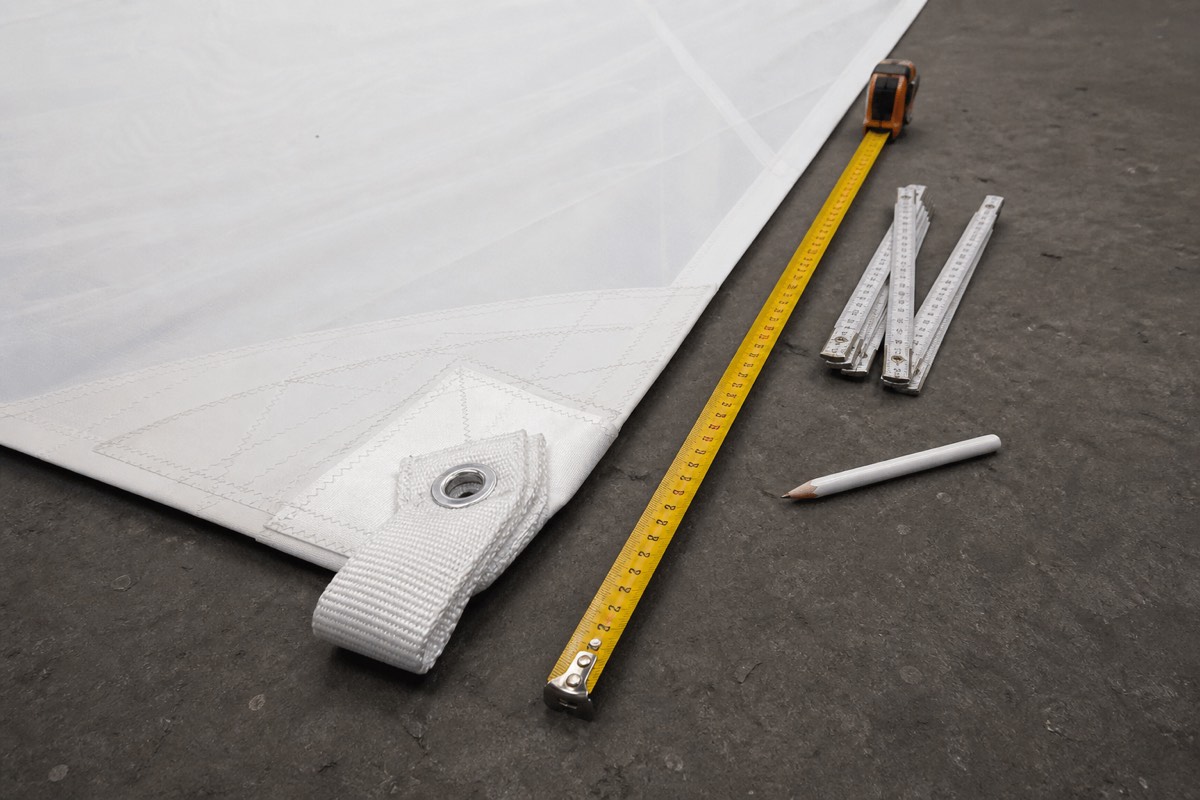
Use a stable long tape, shorter rule, square or straightedge where needed, labels, pencil, camera and the exact loft or class form. The essential tool is a written method that names endpoints, units, sail condition and applied tension so another person can reproduce the reading.
Three checks before you act
- 01Label the sail and reference points before measuring.
- 02Record tool, unit, condition and tension with every dimension.
- 03Repeat critical readings and resolve disagreements before submission.
Choose tools that control ambiguity
A flexible long tape handles edges and corner-to-corner dimensions, but it must be undamaged, readable and long enough to avoid improvised joins. A shorter steel rule or folding rule can help with hardware and local details. A straightedge, square, soft pencil, removable labels and low-tack markers help define stations without marking the sail permanently. Add a clean floor covering, light and weights or helpers appropriate to the loft's requested method.
The camera is a measurement tool when it records endpoints and context rather than replacing dimensions. Take one wide image showing orientation, then closer images with the tape zero, far endpoint and full tape path. Keep the tape in the same plane as the requested dimension and avoid perspective that hides a hook or bend. A ruler placed beside hardware gives scale, but the written reading still matters because a photograph can distort distance.
Build a sheet another person can repeat
Start with boat, sail, date, side, unit and condition. State whether the sail is flat, hoisted or tensioned according to a supplied method. Name each endpoint exactly: head bearing point, tack bearing point, clew bearing point, reef cringle or a station defined on the form. Do not silently substitute a convenient metal edge for the sailmaker's reference. Sketch the point and attach its photograph when terminology could be interpreted two ways.
Record the raw reading before rounding or converting it. If a form requests paired dimensions, take both during the same setup. Repeat any measurement that drives fit, hardware or sail area, preferably with another person reading the tape. When repetitions disagree, investigate tape path, stretch, endpoint and sail movement instead of averaging an unexplained error. The spread itself is useful evidence that the setup is not yet controlled.
Measure the interfaces, not only the triangle
A sail must connect to real hardware. Photograph and measure slides, slugs, shackles, bolt rope, headboard, tack pin, clew attachment, reef points, battens and pockets as the loft requests. For a mast or boom system, record maker, model, section and any relevant serial or manual reference. Seldén's sailmaker guide devotes extensive space to slides, batten receptacles, booms and reef systems, illustrating why a luff or foot length alone cannot establish compatibility.
Package the handoff as one dated set: completed form, raw notes, sketches, photographs and a list of unknowns. Keep a copy unchanged after submission. If the loft asks for a second method or a dimension under different tension, create a new labelled observation rather than overwriting the first. Measurement quality is not the number of decimal places; it is the ability to show exactly where a reading came from and what changed between attempts.
BOUNDARY
Do not invent a missing reference point
If the loft form, class rule or hardware manual does not make an endpoint clear, pause and ask. A precise reading between the wrong points can create an expensive fit error. Never climb, load a rig or tension a sail beyond the documented safe setup merely to obtain a number.
Move from tools to a complete handoff
Follow the full sail measurement checklist, add interfaces from the reefing hardware map, and compare condition with the inspection sequence before sending the package. Sail measurement tools answer questions about cloth and rig, but a sailmaker's habits of measurement travel: a tape, a datum line, a note of what the numbers assume. The same discipline appears in site crowd touring, where a company fixes a playing area, sets crowd thresholds, plans evacuation and reads an unfamiliar site before the first performance. Both pages treat measurement as a working method rather than a fixed figure, and both assume the ground will differ from the drawing.
SOURCES AND DATE
Checked 25 August 2026. Seldén material supports the need for system-specific dimensions and interfaces; the recording protocol is Fieldbook methodology.